
Featured Commercial Teepee & Glamping Tent Systems
Standardized engineering, all-weather durability, and direct export pricing for international hospitality projects.
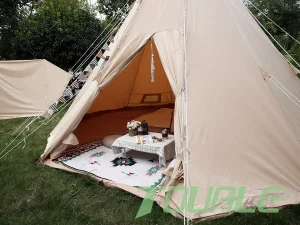
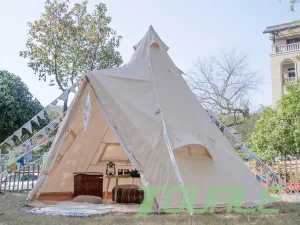
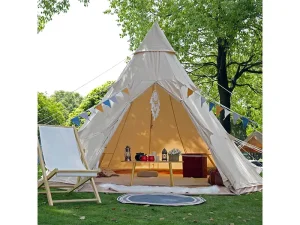
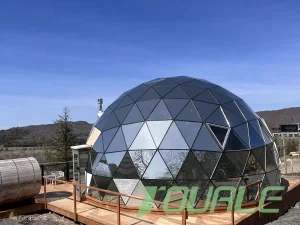
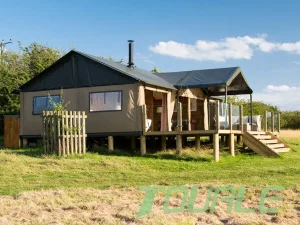
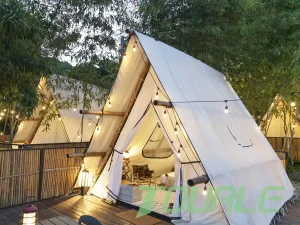
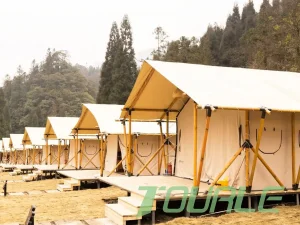
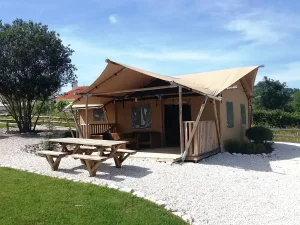
Macro Industry Solutions: The Experiential Hospitality Evolution
How commercial teepee structures are reshaping eco-tourism yields, lowering infrastructure CapEx, and accelerating time-to-market for modern resort operators.
Asset-Light Eco-Resort CapEx
Traditional concrete hospitality infrastructure requires $250k–$600k per key and 18–36 months of zoning and building approvals. In contrast, commercial glamping teepee deployments require under 25% of that capital, operating with minimal foundation footprints and achieving environmental permitting compliance in a fraction of the time.
Yield & RevPAT Maximization
Revenue Per Available Tent (RevPAT) across North American and European glamping resorts consistently outperforms standard mid-tier hotel rooms by 35% to 60% during peak seasons. Conical teepees offer high visual impact, translating directly to higher viral organic social media marketing and elevated nightly rates.
Rapid Turnkey Deployment
Engineered teepee systems utilize standardized modular hardware and tensioning geometry, enabling a trained crew of four technicians to erect up to three full accommodation units per day. This dramatically shortens revenue generation lag time post-land acquisition.
B2B Commercial & Industrial Market Outlook
Analyzing global regional demand drivers, supply chain dynamics, and structural buyer preferences across key international jurisdictions.
North America & European Hospitality Dynamics
In North America (US & Canada) and Western Europe (UK, France, Nordics), the outdoor hospitality market has transitioned from traditional rustic camping to luxury experiential living. Commercial buyers require strict compliance with fire-retardant standards (such as NFPA 701 and California Title 19), heavy snow load capabilities for alpine usage, and fully integrated stove openings for 4-season climate control.
APAC & Middle East High-Yield Developments
The Middle East (GCC region) and Asia-Pacific (Australia, Japan, Southeast Asia) show surging demand for high-peak tension tipis and giant event teepees. In desert environments, heavy-duty anti-UV membrane coatings, thermal insulation liners, and sand-anchoring engineering are mandatory to withstand extreme heat and abrasive windstorms.
Technical Architecture: Engineering Commercial Teepees
From conical wind dispersion geometry to multi-layer thermal canvas systems, explore why engineered tipis outperform standard soft-sided structures.
Aerodynamic Conical Geometry
The traditional tipi cone is inherently one of the most structurally stable natural forms. By shedding wind force evenly across 360 degrees, radial stress concentration is virtually eliminated. Tourle Tent (Sichuan Tulele Technology Co., Ltd.) elevates this baseline geometry with precision CNC-machined steel collar hubs, hot-dip galvanized steel or treated Scandinavian pine poles, and high-tensile guy line tensioners engineered to withstand wind speeds up to Beaufort Scale 10.
Canvas Formulation & Waterproofing
Commercial-grade teepees utilize treated 320–420 GSM cotton-polyester blended canvas or 850 GSM heavy-duty PVC architectural membranes. Fabrics are treated with hydrophobic fluorocarbon coatings providing a water column resistance rating exceeding 5,000mm hydrostatic head, while remaining mold-resistant, anti-rot, and UV-stabilized to prevent degradation over multi-year continuous outdoor exposure.
Engineering Comparison Matrix
Comparing structural parameters across tent typologies used in commercial developments.
| Structural Metric | Commercial Tipi | Pyramid Tent | Geodesic Dome |
|---|---|---|---|
| Wind Resistance | 90 – 110 km/h | 70 – 85 km/h | 100 – 120 km/h |
| Snow Loading | Excellent (Sheds easily) | Moderate | High load capacity |
| Setup Speed | Fast (2–3 hours) | Very Fast (1–2 hrs) | Moderate (4–6 hrs) |
| Ventilation Efficiency | Thermal Chimney Effect | Passive Side Vents | Forced HVAC required |
| Stove/Heater Safety | Integrated Flue Collar | Flue Ring Option | Custom Wall Exit |
Comprehensive Teepee B2B Pricelist Architecture
Understanding factory direct pricing variables, volume wholesale tiers, OEM customization costs, and financial payback models.
When evaluating teepee tent costs, commercial operators must account for structural specifications, canvas grade, hardware finishes, and local logistics. Below is an indicative industry wholesale pricing framework for commercial glamping setups.
| Teepee Category / Model | Diameter / Area | Capacity | Wholesale Tier (1–10 Units) | Bulk Tier (50+ Units) | Key Applications |
|---|---|---|---|---|---|
| Standard Cotton Tipi (4-Season) | 4m Diameter / 12.5㎡ | 2–4 Persons | $380 – $650 / unit | $290 – $480 / unit | Glamping start-ups, family camping, pop-up events |
| Luxury Glamping Pyramid Tipi | 5m Diameter / 19.6㎡ | 4–6 Persons | $620 – $980 / unit | $490 – $750 / unit | Resort guest rooms, glamping rentals, eco-lodges |
| Heavy-Duty Commercial Tipi | 6m Diameter / 28.2㎡ | 6–8 Persons | $950 – $1,600 / unit | $780 – $1,250 / unit | Master suites, lounge tents, high-end guest keys |
| Giant Event & Catering Tipi | 10m–13m Linkable | 30–80 Persons | $3,800 – $7,500 / unit | $3,100 – $5,800 / unit | Weddings, outdoor dining, corporate venues |
CapEx & Payback Period Calculation
Assuming an all-in unit investment of $1,200 (including 6m Teepee tent, internal furniture, deck platform, and electrical rough-in) and an average daily rate (ADR) of $150 at a conservative 45% annual occupancy rate:
- Annual Gross Revenue: $150 × 365 × 0.45 = $24,637
- Operating Expenses (30%): $7,391
- Net Annual Operating Income: $17,246
- Payback Period: Under 3 Months
OEM / ODM Customization Factors
Factory custom options impact overall unit cost but unlock strong brand differentiation:
- Custom canvas pantone dyeing & logo screen printing
- Upgraded silicone stove flue ring pass-throughs
- Insulated multi-layer thermal inner linings
- Customized heavy-duty PVC mesh bug screening
Freight & Container Logistics
Maximizing container loading density is vital for international shipping efficiency. Standardized teepees pack into compact carton bundles. A single 40ft High Cube (HQ) shipping container can hold up to 280 units of 5m teepee tents, significantly driving down per-unit ocean freight costs.
Global Localization & Structural Safety Standards
Navigating regional building codes, fire regulations, and environmental safety protocols with certified manufacturing.
Fire Safety Standards
Tourle Tent materials are certified against major international fire safety mandates, including NFPA 701 (USA), DIN 4102 B1 (Germany/Europe), and CPAI-84 canvas flame retardancy standards. Fire retardant treatments are chemically bonded to canvas fibers, retaining efficacy through repeated rainfall cycles.
Stove Opening Thermal Engineering
To support true 4-season alpine glamping, teepee units come pre-equipped with high-temperature silicone chimney collar jacks capable of withstanding continuous temperatures up to 300°C (572°F). Secondary fire-resistant canvas flaps seal the opening when stoves are not in use.
Structural Eurocode Compliance
Engineered structural frames comply with relevant structural load calculations (including Eurocode 1 actions on structures). Anchorage options include heavy steel earth stakes for turf/sand, chemical anchor bolts for concrete pads, and weight-plate collar systems for sensitive eco-zones.
Localized Application Scenarios & Case Studies
How operators leverage teepee structures across diverse geographic topographies and business verticals.
Alpine Snow Resorts
Equipped with internal insulation liners and wood-burning stoves, 5m and 6m teepees function as cozy winter guest suites in mountain campgrounds, maintaining internal temperatures of 20°C (68°F) in freezing sub-zero ambient conditions.
High-Desert Eco Lodges
Utilizing high-solidity UV-resistant canvas and dual-layer zipped mesh doors, desert glamping operators achieve passive cooling through top apex thermal venting while keeping fine dust and insects out.
Weddings & Pop-Up Dining
Giant linkable event tipis allow hospitality venues to host 100+ guest banquets. Canvas walls can be raised to create open shade canopies during summer or sealed against rain storms.
Family Glamping Suites
Teepees with high center heights allow space for king-size bed frames, side tables, and lounge chairs, creating attractive family units that command premium room rates.
Technical Roadmap & Future Outlook
Pioneering next-generation sustainable materials, smart environmental integration, and modular manufacturing.
Photovoltaic Canvas Integration
R&D is focused on integrating flexible, thin-film solar cell strips directly onto the outer roof cone, generating off-grid power for LED lighting and mobile device charging without compromising aesthetic appeal.
Smart HVAC & Sensor Connectivity
Integrating modular HVAC duct ports and IoT climate sensors allows resort managers to monitor internal humidity, temperature, and canvas tension remotely from a centralized management portal.
Circular Economy Recycled Fabrics
Moving towards 100% recycled polyester blend canvases (rPET) derived from post-consumer plastics, reducing lifetime carbon footprints for environmentally certified eco-resorts.
Explore Additional Glamping & Tipi Systems
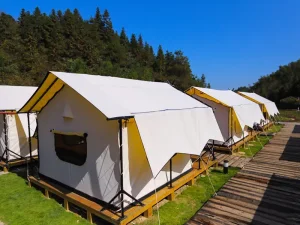
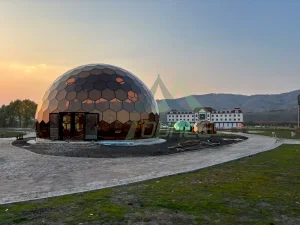
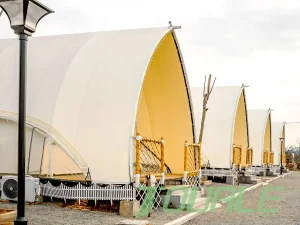
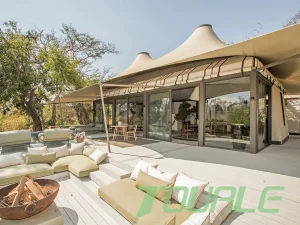
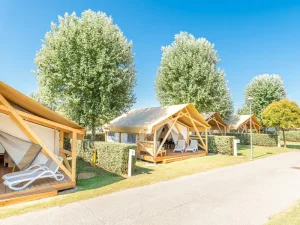
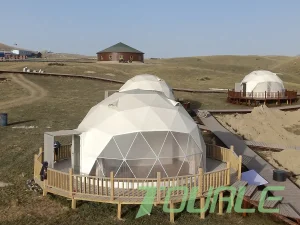
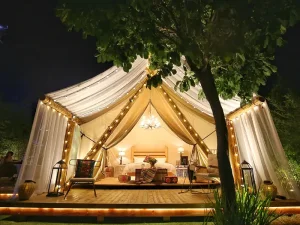
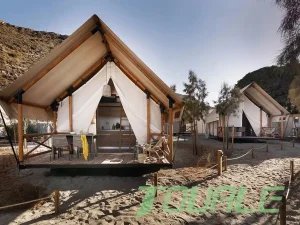
Standardized models, custom luxury safari tents, and geodesic domes engineered by Sichuan Tulele Technology Co., Ltd.
Frequently Asked Commercial & Technical Questions
In-depth answers covering manufacturing provenance, customization parameters, quality control, and international deployment support.