
Top-Tier Hotel Tent Engineering Solutions (Catalog Part 1)
Explore our structural grade, UV-treated, fire-retardant hotel tent configurations manufactured for international eco-resorts and luxury glamping operators.
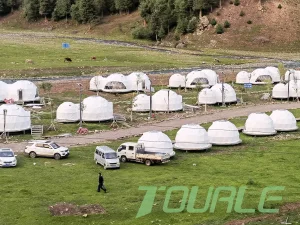
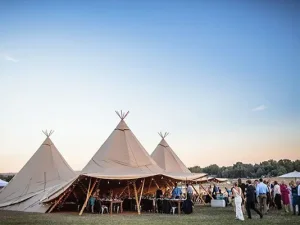
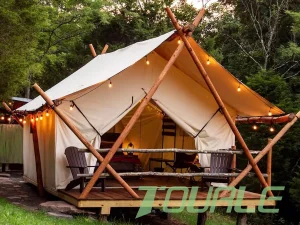
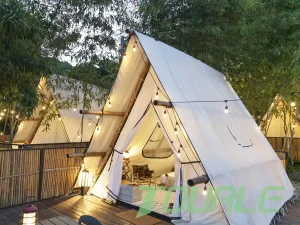
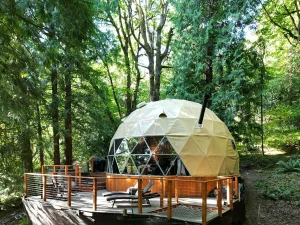
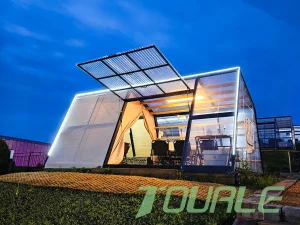
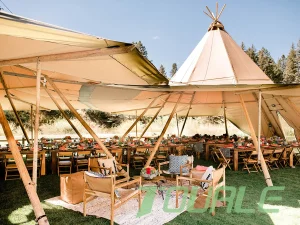
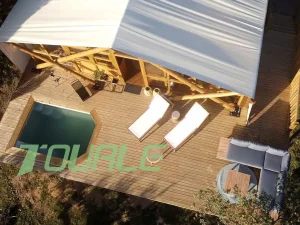
The Global Commercial & Industrial Landscape of Tent Hotels
Analyzing the shift from traditional brick-and-mortar hospitality to asset-light, eco-conscious modular tent architectures.
Exponential ADR & Occupancy Growth
Global hospitality analytics demonstrate that semi-permanent tent hotels consistently achieve 30% to 50% higher Average Daily Rates (ADR) compared to traditional hotel rooms in similar geographic locations. Modern eco-travelers actively seek immersive natural stays without surrendering 5-star climate control, plush sanitary facilities, or architectural aesthetics.
Asset-Light & Fast Land Approval
Because structural glamping tents, geodesic domes, and safari lodges utilize non-permanent foundation systems (such as elevated wooden decks, helical screw anchors, or ballast bases), resort developers bypass lengthy municipal building permits. This cuts project launch timelines from 24 months down to under 90 days.
Rapid Capital Payback (ROI)
With initial capital expenditures (CapEx) per key ranging between $15,000 and $45,000—a fraction of the $150,000+ per key required for concrete hotel construction—resort operators regularly achieve complete capital payback within 12 to 18 months of operation.
Structural Materials & Engineering Specifications
A deep engineering benchmark showing why professional tent hotel buyers demand factory-grade materials designed for long-term outdoor exposure.
Technical Information Gain: Membrane & Alloy Comparison
Unlike consumer-grade camping gear, commercial hotel tents must endure continuous thermal expansion, UV degradation, heavy rain loads, and hurricane-force wind shear. Below is the structural material standard enforced at our Sichuan production facility (Sichuan Tulele Technology Co., Ltd.):
| Structural Component | Standard Commercial Grade | Tourle Tent Industrial Grade | Operational Impact |
|---|---|---|---|
| Main Frame Alloy | Standard Steel / Untreated Timber | T6061-T6 Aluminum / Q235 Hot-Dip Galvanized Steel (80-120μm Zinc) | Prevents internal structural rust for 15+ years; withstands severe coastal saline air. |
| Outer Roof Membrane | 500g/m² Standard PVC | 850g/m² PVDF Coated Architectural Membrane (Tensile: 3000N/5cm) | Self-cleaning surface, anti-mildew, 100% waterproof (Hydrostatic >3000mm), UV50+. |
| Inner Wall Fabric | Single-layer polyester | 420g/m² Ripstop Cotton Canvas or Double-Sided Insulated Composite Layer | High thermal resistance (low U-value), sound absorption, breathable moisture control. |
| Fire Retardancy | Non-certified / CPAI-84 | DIN 4102 B1 / NFPA 701 / EN 13501-1 Certified | Meets strict municipal commercial lodging safety codes and hotel insurance mandates. |
| Hardware & Connectors | Stamped sheet iron | In-House Laser-Cut CNC Q355 Steel Connectors with Dacromet Coating | Eliminates structural joint failure under high wind torque and heavy snow load pressure. |
Chinese Manufacturing Efficiency & Supply Chain Mastery
How Sichuan Tulele Technology Co., Ltd. leverages integrated production to lower lead times and secure uncompromised quality control.
In-House Hardware Manufacturing Since 2019
Unlike assemblers who purchase off-the-shelf brackets, we established a dedicated hardware plant in 2019. We independently stamp, CNC-cut, weld, and galvanize every hub connection, baseplate, and tensioner, ensuring zero assembly discrepancies on site.
Full-Process Pre-Shipment Trial Assembly
To prevent overseas installation delays, 100% of custom glamping orders undergo a complete trial assembly in our 18,000㎡ Chengdu factory prior to packing. Structural stability, fabric tensioning, window alignment, and hardware fittings are rigorously inspected.
Integrated Supply Chain & Rapid Turnaround
Leveraging Chengdu’s robust industrial ecosystem and direct connections to European and Pan-Asian freight hubs, we produce large-scale resort orders within 25–35 days—half the industry standard—reducing project shipping costs by up to 20%.
Localized Application Scenarios & Extreme Climate Engineering
How specialized structural engineering permits year-round operation across diverse geographical ecosystems.
Desert & High-UV Environments
Deployment Examples: Middle East, Southwestern USA, Australian Outback.
Technical Adaptation: Dual-layer PVDF roof membranes featuring TiO2 heat-reflective coatings reduce interior ambient temperatures by up to 12°C. Integrated UV-stabilized clear PVC viewing panels prevent yellowing and thermal degradation under intense solar radiation.
Alpine & Heavy Snow Zones
Deployment Examples: European Alps, Northern Japan, Rocky Mountains.
Technical Adaptation: Geodesic dome frames engineered with reinforced 60mm structural steel tubing calculated for snow loads exceeding 0.5 kN/m². Outfitted with multi-layer foil insulation liners and integrated stove chimney jacks for sub-zero comfort.
Tropical & Coastal Marine Belts
Deployment Examples: Southeast Asia, Caribbean, Coastal Resorts.
Technical Adaptation: 6061-T6 structural aluminum poles and marine-grade 316 stainless steel hardware withstand salt spray fog. High-tension mesh window systems allow cross-ventilation while excluding insects, paired with 100% mold-resistant outer canvas.
Global B2B Procurement Criteria & Financial Modeling
A structured blueprint for resort investors, purchasing agents, and campsite operators evaluating hotel tent manufacturers.
Key Procurement Checklist for Commercial Resort Projects
- Modular Utility Integration: Does the frame accommodate concealed plumbing, high-amp electrical wiring, and split-system HVAC ducting?
- Shipping Density Optimization: Are structural components designed for nested knockdown packing into standard 40ft HQ containers to minimize freight cost per key?
- Structural Wind Load Certification: Does the supplier provide wet-stamped engineering calculations verified for local wind pressure codes?
- Spare Parts Availability: Are structural hubs, replacement canvas covers, and tension cables stock-backed for immediate international dispatch?
| Resort Scale Model | Typical Unit Count | Average CapEx / Unit | Estimated Daily Rate (ADR) | Projected Payback Horizon |
|---|---|---|---|---|
| Boutique Eco-Campsite | 5 - 10 Units | $12,000 - $18,000 | $150 - $250 / night | 8 - 12 Months |
| Mid-Scale Glamping Resort | 15 - 30 Units | $20,000 - $35,000 | $280 - $450 / night | 10 - 14 Months |
| Luxury 5-Star Wilderness Lodge | 35+ Units | $40,000 - $75,000 | $600 - $1,200 / night | 12 - 18 Months |
Commercial-Grade Resort Tent Series (Catalog Part 2)
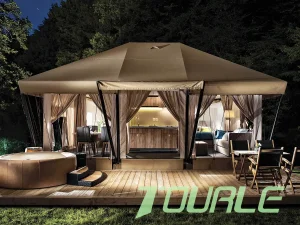
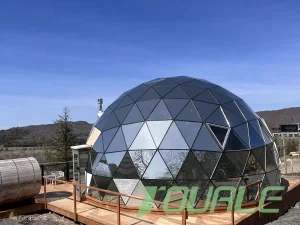
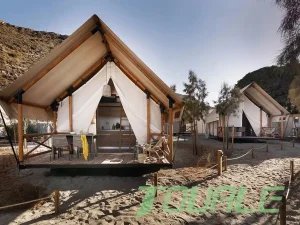
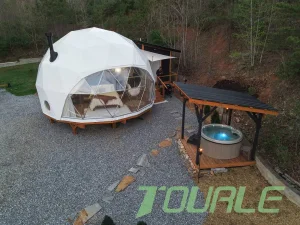
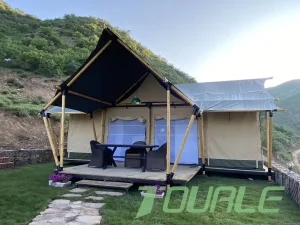
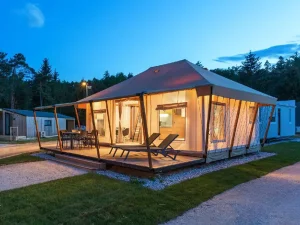
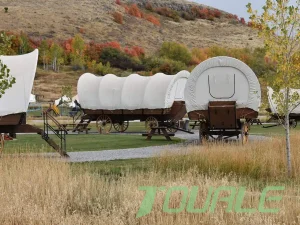
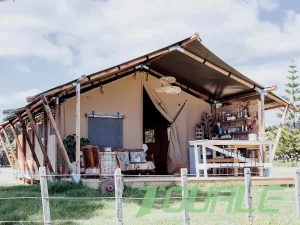
Heavy-duty safari lodges, spherical stargazing domes, and modular event tipis available for OEM brand customization and bulk global export.
Emerging Trends in Hotel Tent Engineering & Eco-Design
Key technological advancements driving the next decade of luxury outdoor accommodation.
Off-Grid Utility Self-Sufficiency
Modern developers prioritize zero-footprint implementations. Next-generation tent structures incorporate flexible BIPV (Building-Integrated Photovoltaics) into roof canvases, paired with compact greywater filtration circuits and low-voltage DC climate systems.
Glass-Membrane Hybrid Architecture
Transitioning beyond flexible PVC films, high-end resorts deploy tempered double-glazed low-E glass panels set within aluminum geodesic grids. This achieves superior acoustic isolation (R_w > 38dB) and heat insulation matching permanent hotel structures.
IoT-Enabled Smart Room Controls
Luxury glamping lodges now feature automated micro-climate controllers connected to motorized ventilation skylights, ambient LED strip lighting, and keyless RFID access locks designed to work smoothly in remote wilderness settings.
Frequently Asked Questions & Technical Insights
Addressing core technical, financial, and logistical queries from international project engineers and developers.