1. Global Macroeconomic Status & Industrial Demands
High Rental Rate Monetization
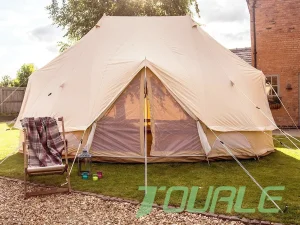
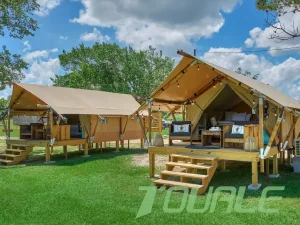
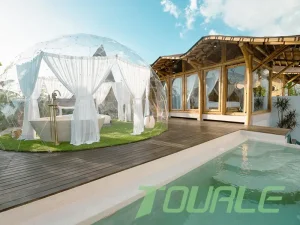
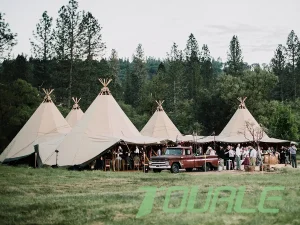
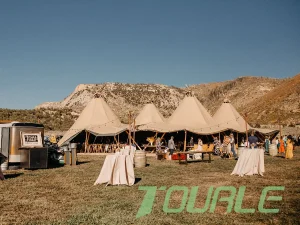
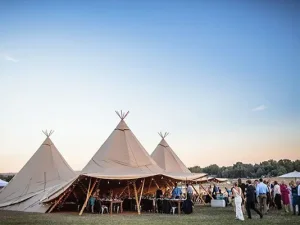
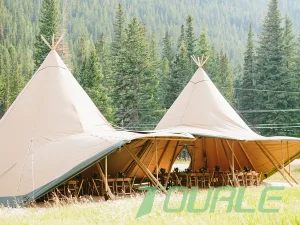
Wedding tipis command premium rental margins—often 40% to 60% higher than standard white frame tents—due to their aesthetic appeal and immersive, atmospheric interiors.
Modular Spatial Scalability
By raising canvas skirts and utilizing zip-linked tunnel interfaces, multiple tipis can be seamlessly joined to accommodate guest capacities ranging from 50 to over 500 people.
Four-Season Structural Resilience
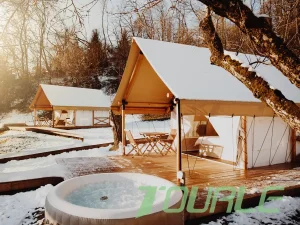
Engineered with heavy-gauge slow-grown solid timber poles and high-tensile technical canvas, professional tipis withstand high wind loads and moderate snow accumulation.
2. Technical Materiality & Manufacturing Blueprint
Timber Engineering & Pole Fabrication Standard
| Structural Component | Material Benchmark Standard | Factory Processing & Treatment | Commercial Performance Benefit |
|---|---|---|---|
| Main Support Poles | Slow-grown Larch / Douglas Fir (Ø 80-120mm) | Kiln-dried to <14% moisture; bark stripped; machine sanded; anti-fungal dip coating | Eliminates internal splitting, prevents warping under load, and extends structural service life to 10+ years. |
| Skirt Poles & Struts | Precision-turned Laminated Timber or Solid Pine | Multi-coat exterior polyurethane / UV-inhibitor sealers | Ensures lightweight, rapid manual deployment while resisting moisture rot during ground contact. |
| Technical Canvas Cover | 500GSM - 650GSM Poly-Cotton / 100% Cotton Canvas | Fluorocarbon waterproofing, flame retardant (DIN 4102 B1 / NFPA 701), anti-microbial treatment | Delivers complete waterproofing (>5000mm hydrostatic head), tear resistance, and full fire safety compliance. |
| Connecting Hardware | Hot-Dip Galvanized / Q235 Structural Carbon Steel | Laser-cut, robotically welded, zinc-plated finish (>85μm thickness) | Prevents corrosion from humidity or coastal exposure; provides high shear-strength joint load distribution. |
Aerodynamic Performance & Load Metrics
3. Localized Field Application Scenarios & Regional Engineering
North American Market Compliance
In North America, commercial event structures must strictly comply with local fire safety codes (NFPA 701, CPAI-84) and engineering wind-load documentation for permitting. OEM factories supply structural engineering calculations and certified flame-retardant fabric documentation required by local building departments.
Western European Eco-Heritage Sites
European venues frequently operate on historic or environmentally protected land where heavy machinery is prohibited. Wooden tipis leave a minimal ground footprint, utilize ballast anchoring systems when ground staking is impossible, and integrate naturally into rural, coastal, and forest landscapes.
High-Humidity APAC & Coastal Resorts
In tropical or monsoon-prone areas like Southeast Asia or coastal Australia, canvas covers require intensive anti-fungal treatment and specialized mildew protection coatings. Reinforced ventilation caps and zip-in mesh wall panels promote air circulation while keeping out insects.
4. Total Cost of Ownership (TCO) & Commercial Return on Investment
| Financial Metric | Typical Intermediate Distributor Model | Direct Factory OEM/ODM Procurement | Net Operational Savings / Advantage |
|---|---|---|---|
| Initial Capital Outlay (3 Tipis + Links) | $45,000 - $60,000 USD | $22,000 - $32,000 USD | Up to 45% CAPEX Reduction |
| Average Weekend Rental Rate | $5,500 USD per weekend | $5,500 USD per weekend | Identical top-line market revenue potential |
| Setup Labor & Deployment Time | 4 Crew Members / 5 Hours | 4 Crew Members / 4 Hours (Modular Fittings) | 20% reduction in site labor costs |
| Investment Payback Period | 9 - 12 Booking Events | 4 - 6 Booking Events | Payback achieved within first operating season |
5. Frequently Asked Questions (B2B Procurement Guide)